How to succeed with content while increasing ROI

Whether you start your day with a coffee, walking the dog, spinning etc., whether you are in New York, Copenhagen or Singapore, you check a feed, your phone or something that contains content. It may not be the first thing, or third, but it’s probably in top 10. And you don’t just check a feed; you check YOUR feed, a feed personalized by yourself. A feed that you have been working on since you decided to get on that channel. Every morning kicks off a routine of “open-scroll-engage” which is repeated numerous times during the day. Sometimes spiced up with a “share” added to the equation. But have you ever thought of why you’ve chosen the sources you have, why you’ve chosen the platforms you have and why is it that you have chosen to let content providers such as New York Times to Red Bull to a Seth Godin to a specific friend make up your daily news feed? It’s probably because they provide you with content that matches what you want to be informed about, who you are, your interests and who you desire to be.
Consumers aren’t that different after all, when adding content to their feeds. They choose based on the exact same perimeters. In order to increase awareness, engagement, leads, conversion and in the long run revenue, your brand has to match the perimeters of your target group. So how do you get your brand to that point, the point where you gain the full potential of your content marketing strategy?
To answer that question we have designed a process (tested and approved) called The Temple Approach that can be used to bring your brand closer to being selected. We will not give you the answer on how to create great content, which is a premise of even being considered by the consumer, but the process will help you establish a framework that will make it easier to understand how content should be formed and how you will distribute it correctly. Thereby getting a lot better ROI on your content strategy.
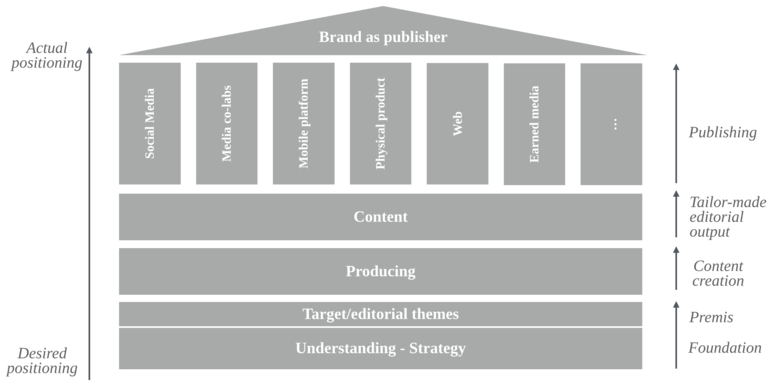
The Temple Approach
As a brand you want to be a powerhouse, a quality stronghold, but houses don’t last that long. So why not build a temple? A temple has been seen to stand for centuries, outlasting wars and climate changes and it tends to grow as new possibilities and techniques develop. This approach will also help you increase your ROI on content as it increases the success rate and limits the pitfalls on everything you publish. And as a bonus you can cut media expenditure when executing your content strategy if you do it through the temple.
Foundation and premise – the concrete
First of all – who are you going to build a temple for and why are you building the it?
Your temple stands on a foundation of knowledge. The stronger the understanding, the stronger the foundation. The result of this process should be you comparing your brand values to the core interest of the target groups, match them, creating the perfect basis to determine your “editorial themes”
The editorial themes – The colour scheme
In order to reach your target group with most optimal output, create an editorial plan. It’s a plan, that structures the frequency, scope and direction of your content production and publication. In order to make this plan, you need to define editorial themes, which should reflect your desired communicative target. And these themes should correspond with your insights and cover 3 areas: Inspiration, Information and Involvement. The exact number of themes, depend on what’s most relevant for your brand and target group.
Example: If you are a spirit brand and your insights told you that your target group is mostly interested in how they make great cocktails, you can educate them using your products and thereby giving them something of real value. A match and theme of “Education & inspiration”.
The production – the boiler room
In order to create the most optimal output you need to engage with a strong team of producers. Choose people who have an understanding of what triggers the target group, understands what’s relevant and trustworthy, and even more important, what’s not. Sometimes your target group will make a great deal of who creates the content, and so you should focus on the trustworthiness of the content producers. Sometimes, people just want a good laugh or a good, easy tool, with no need to know who made it.
As long as the production is managed with the desired purpose, editorial theme and target group in mind and as scope, you increase your success potential of having people to choose your content. Read more about how to create a winning content team.
The content – the show
Content is not a new word, and it’s meaning should be taken literally. Content is the result of everything that a brand chooses to activate. Everything from a blogpost to an event to a mobile app. Content is what your temple is filled with. It is the result of your production. This is the gold that you have created. The content should reflect your editorial themes, or in other terms, your editorial themes should be a guideline for your content. Remember that the content you have created is trustworthy and relevant, as it is created with basis in the target group.
The publication – the columns
So far so good – now you have to distribute the content; a process even more important than the production itself. This is where your strategy stand its most important test. If you publish your content with the right combination of media channels with the right frequency you are likely to succeed. That demands an insight on how media channels are consumed today and even more a high digital and social understanding. If not, you increase the possibility of failing. The purpose of the content should determine which channels to distribute it along with the overall strategy and goal. You need to choose the right media channels for each piece of content.
The Greek gave us three different types of columns – we give you 40+. These are your media channels. This is where you publish and seed your content according to your editorial plan. They can be anything from a newspaper to a blogger to a tech conference to a push notification triggered with help of iBeacons. Having people speek on your behalft without clearly being sponsored, is what should be reached for.
The inauguration – raising the rooftree
It is important to say, that you should never skip any parts of the temple. If you do, it will result in a fragile part of the house, increasing the possibility of it collapsing. If you leave one of the levels out, it will for sure collapse, cause what will the other levels then rest on? Especially when it comes to the columns. The roof will not be able to rest upon one narrow column. It will tip. On the other hand, it is not a case of “the more the merrier”. You need to choose the columns that are right for who is going to be exposed to the house and who will use it. Only then will the roof fit perfectly. One too many, will look wrong, one too little will make it unsteady. Remember, it is all a matter of balance.
Maintaining your temple
You should never let anything be left alone. You should always measure your performance. The climate might change, and you should be ready to take that on, to adjust your “temple”. Always test to see if the temple can stand, measure it, and if not, adjust it. If not, it will probably not withstand hence collapse. Working with content and using it as a branding and marketing tool is an on-going process and it should be. Would you for example read a newspaper that only published one story each week, at nighttime, and what if that story was about themselves? But it also demands something of you. You should also always stay on top of how things evolve, how your industry is changing, how the “mechanics” are etc., or better yet, have an agency help you with it.

 Trine Keller-Andreasen