How do you measure a retweet from a leading opinionist? And can you actually measure the total value of it? The answer is: not quite. There are too many different intangible factors of influence, but we are willing to give it a shot anyway.
The tweet can be measured in many ways, both quantitative and qualitative, tangible and intangible. Quantitative in terms of reach, favorites, retweets, and qualitative in terms of addition to brand love, brand recognition, brand awareness. One thing is certain the effect of content marketing can’t, as many other things in life, be measured by merely one business metric. One business metric will not give you a thorough indication of a successful activation unless of course you only aim to generate a higher number of followers. If you do that, you should start with reconsidering your overall content marketing strategy and its target as that should never be your only goal. More about the metrics of measurement later.
The initial parameters we all looked at when commencing content marketing and especially community management, were the amount of fans, followers, likes and subscribers. After that came “engagement rate”, which gave us an idea of how many “likers” actually engaged with our content. This did still not give us a clear impression of whether the interaction was positive or negative. While a “like” is a positive recognition in most cases, the character of comments and the comments tagged to the shares of your content were not determined.
Then came the different management systems such as KOMFO, SumAll, Perculate etc., that (overall) scanned and showed you if the interaction had positive, neutral or negative character.
Shares are good, unless they are negative. But then again, some might think that all press is good press, and in that case, all shares are good shares.
The great thing about shares is that it indicates that you have created content that sparked an emotional reaction within your audience. And as a wise woman once said, ”people don’t always remember what you say or even what you do, but they always remember how you made them feel.” (Maya Angelou)
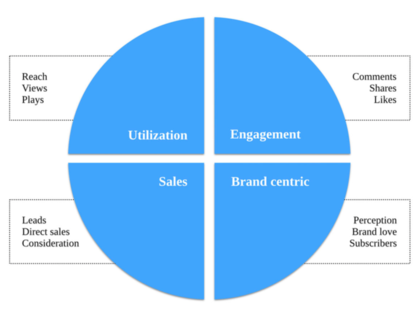
As stated, one metric is not enough to thoroughly assess your online content activation. Instead you should gather an array of metrics based on your desired target. The metrics should be chosen from four primary “buckets”:
- Utilization
- Engagement
- Sales (Lead and conversion)
- Brandcentric
Utilization
This represents the total consumption of your content; how many people have seen it, how many viewed your video and how much did they view it.
Organic reach is good. But reach can also be paid, hence give no actual indication of the quality of the content. This is why a more interesting number to look at is the engagement per reached. In this you will see a ratio of how many has engaged with your content.
Engagement
Engagement has naturally become more interesting to look at than reach. Egagement shows if your content was interesting enough for people to express their immediate feelings towards it. This also looks to the importance of sharing, whether the nature of the comments being positive or negative. Going further, you can use the different content management systems to look at the engagement rate of your content across categories along with posting time during the day, with the purpose of optimizing your performance, both in terms of engagement but also in terms of your desired sales output etc.
Brand centric
These are the qualitative values measured from an activation. They are not immediately obtainable and mostly require more research. Though some things can give an indication, e.g. looking at the nature of the comments made, which can show if the likability has gone up or not. Don’t worry, many of the content management services offer this.
Another indicator could be the number of subscribers or the number of followers. This is often a good indication of how you are performing overall, as users have chosen to take a deeper step towards building a relationship with you. Unless you have bought likes or gone likehunting, then the importance of this metric is washed out.
Finally, many use their social media platforms for customer service functions, and handled properly through qualified community management, you can enhance your brand perception and likability this way. This happened to the Danish State Railways (DSB), believe it or not.
Sales
What it all comes down to your target may be to increase brand love or engagement, but at the end of the day, those are merely a way to increase sales, unless you’re not in it for the money.
Sales can be measured on either direct or indirect sales. For your web2shop content the direct target is to create trial or rebuy, but your content can also have a derived effect or increase the positive brand perception hence drive purchase consideration.
Overall verdict of campaign / content performance
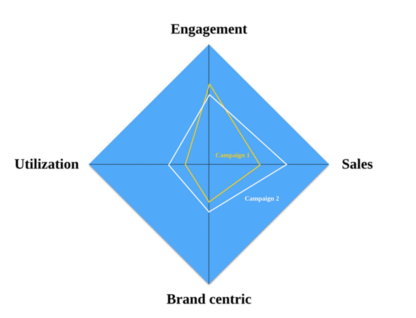
So how do you use the gathered (big) data for something useful? In order to determine the overall performance under each of the metrics, rating each metric with an overall grade is an option. These grades will make it possible for you to compare different campaigns, and quickly spot areas for optimizing, and in which areas you are on to something good; all with the main purpose of improving your ROI.
ROI
You can use many of the parameters above to measure your ROI. As said, it all depends on your target. Your target should be defined by the 4 metrics, e.g;With an investment of $3.000, you would like resulted in a total utilization of 12.000 in reach, engagement of 230 likes and 15 shares, and an increase in consideration of 10% and 5% in Brand Love.Following the campaign, score the results on a scale from 5 to 5, 110, percentile performance, 15 or what ever suits you, and measure it against the target.
You can, if you are a fan of simplicity, merely look at the contact price, but this will give a thorough impression. If you only look at the contact price for a branddriving piece of content, it will not give you a good impression of whether it has been a good investment or not, as your target is qualitative, but your metric is quantitative. So add e.g. contact price vs. brand love for a more thorough impression.
A good rule of thumb is (as in most situations) to reach an ROI of minimum 1. Measuring this can be by looking at the contact price. That’s a good and simple solution and something that relates to something most marketeers are used to. You can also look at the increase in brandlove vs. the total investment, or leads vs. investment, or maybe even leads vs. brand love. Many things are interesting, but all should be reflected in your target, both overall and specific.






 Trine Keller-Andreasen